Journal
Why is my nose crooked in photos but not in the mirror?
The mirror flips you and the camera does not. Learn why a nose can look crooked in photos, and how to tell an angle from a real deviation.
 Hannah Bellamy
The short answer
The mirror shows you a reversed face. The camera shows the real one. That is often enough to make a nose look off to one side.
Add a little head turn and a close lens, and a perfectly ordinary nose can look crooked in one photo and straight in the next.
Here is our model, front on.
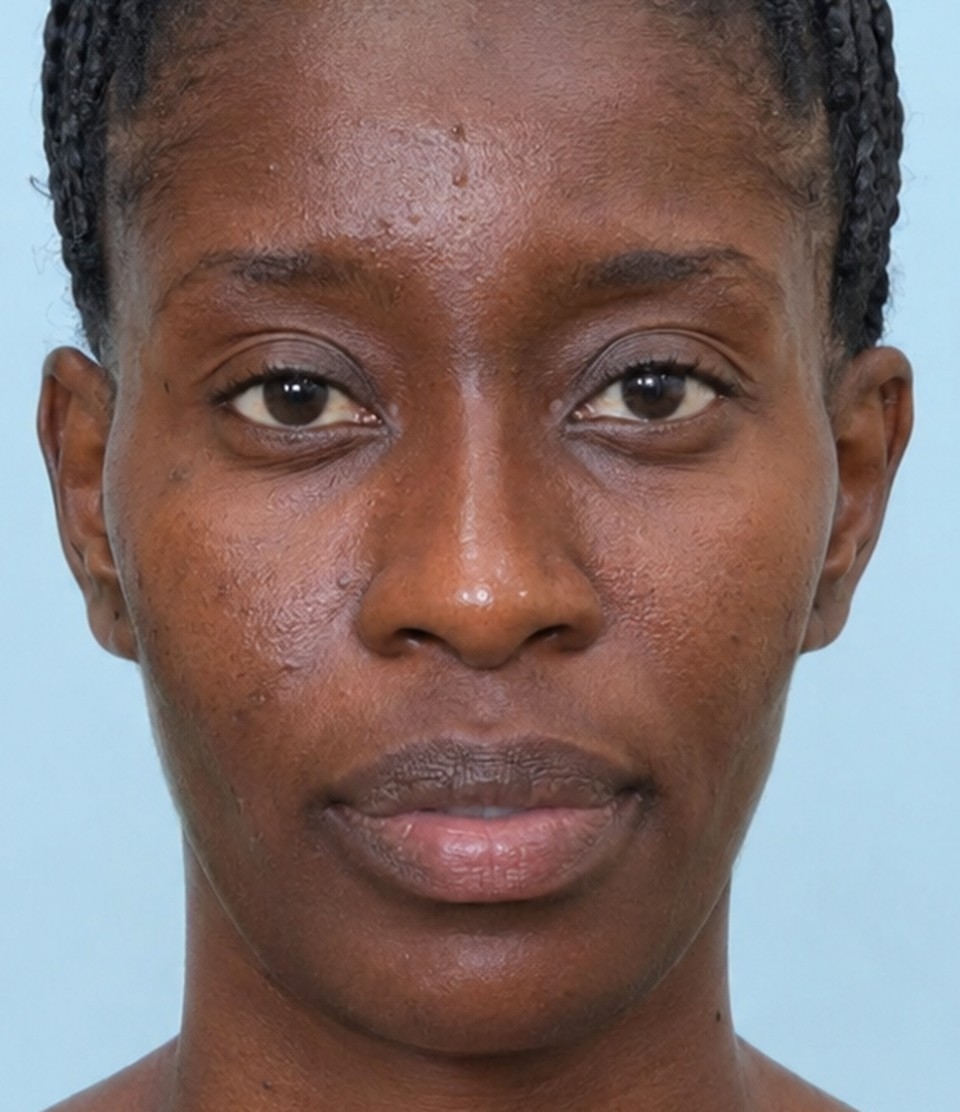
The mirror flips left and right
A mirror swaps your left and right. A camera does not.
You have seen your flipped face thousands of times. It feels like “your face”.
Every face has small differences between sides. The nose may sit a little off the midline. One nostril may be rounder. The tip may lean a few millimetres.
In the mirror you stop noticing. In a photo you see the other version, and the difference stands out.
A flip test with one photo
This is the simplest check. Take one straight on photo and flip it in any photo app.
Put the two side by side. If one looks straighter to you, the issue is mostly familiarity, not shape.
We did this with our model. Same photo, flipped, no other edit.
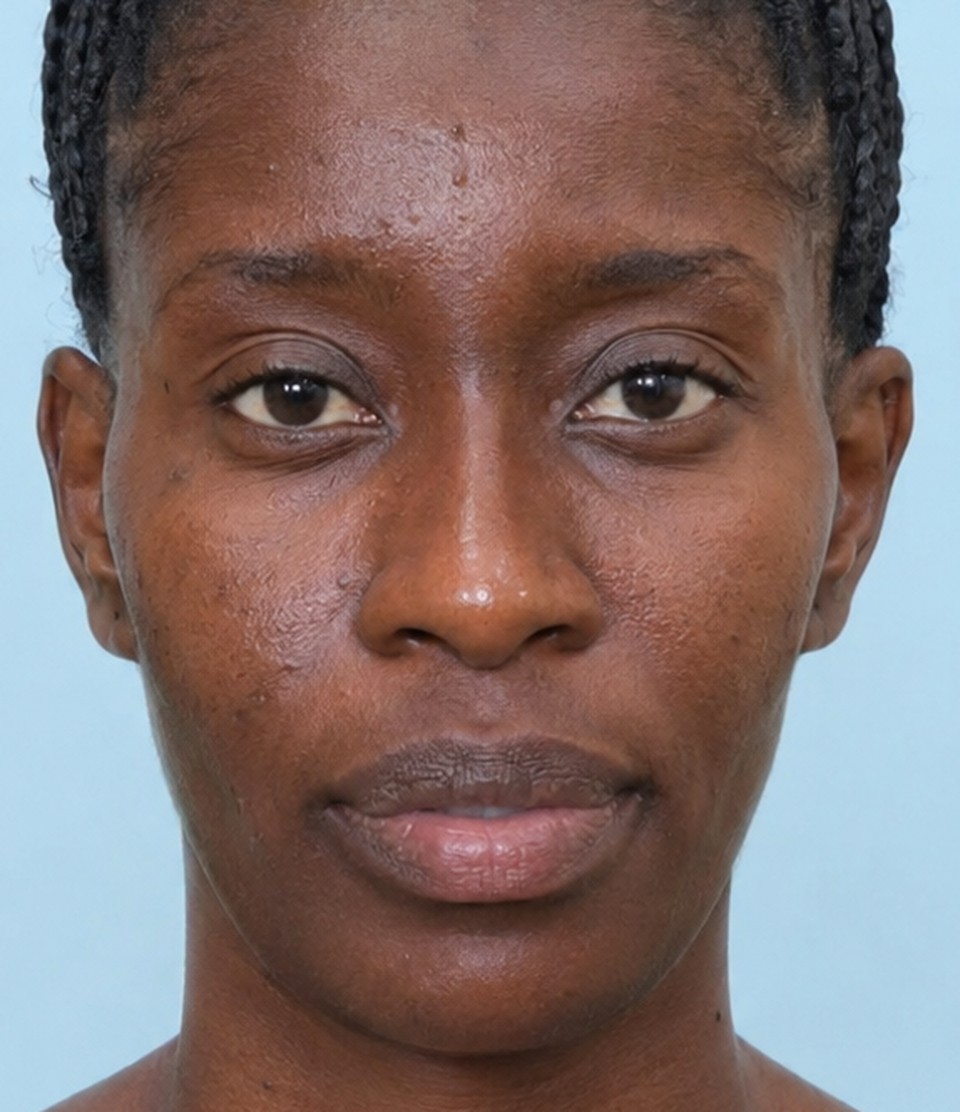
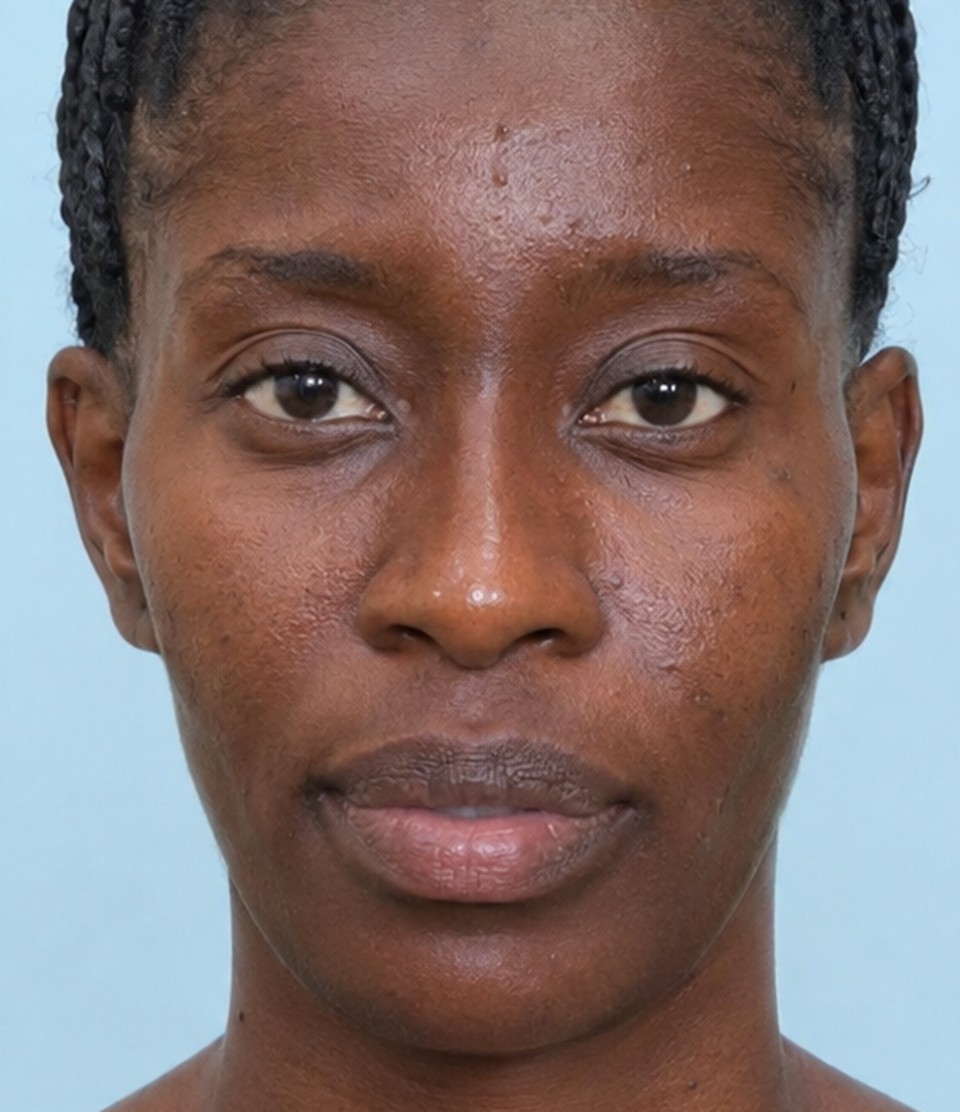
Look at the tip and the line from brow to tip. Small differences move to the other side.
The face is exactly the same. Only your habit changes.
Camera angle is the second culprit
Turn your head even five degrees and the nose shifts against the cheeks. A slim nose will lean toward the side you turn away from.
Chin up, and the tip moves up. Chin down, and the nose looks longer and the tip hides.
Many selfies are taken with the phone slightly to one side. Most of us have a “phone hand” and a preferred angle.
A useful rule: the nose should sit on the line between the eyes and the centre of the lips. If your head is turned, that line is no longer vertical in the photo.
Lens and light can bend a straight nose
At arm length or closer, the nose is the nearest feature and gets stretched. Any small lean is magnified.
Side lighting can make one half of the bridge bright and the other half dark. The dark half reads as a bend.
To check, take a photo at 2 m with soft light from the front. Many “crooked” noses straighten out.
Quick list for a fair photo:
- Look straight into the lens, not at the screen.
- Keep your ears level, with neither side lifted.
- Use a distance of at least arm length.
- Light from the front or window, not from one side.
When it really is a bend
Sometimes it is not the camera. A real deviation shows up in every photo, flipped or not, from any distance.
It can start from birth, from growth, or from an injury. It may involve the bones, the cartilage or the septum, which is the wall inside the nose.
A clinician checks three things: where the bridge sits against the midline, how the tip leans, and how the nostrils compare.
Most “crooked” noses are small shifts, and a few millimetres shows on a face. That is why the flip test and a straight, fair photo come first.
Our model’s nose is slim with a defined tip, and in both versions of her photo it reads as a straight, balanced nose. Only the side it favours changes.
Crooked and breathing
Shape and function are two questions. A nose can look straight and still block, or look bent and breathe well.
If one side stays blocked, you struggle to breathe through your nose, or the nose changed shape after a knock, see a doctor. Do not wait for a photo to decide.
A deviated septum can be treated for breathing, and a clinician can tell you which problem you have.
A simple line check on a photo
You can test your nose without any app. Print a straight on photo, or use a screen with a ruler.
Draw one vertical line through the centre of the forehead down to the middle of the chin.
Then look at where the bridge, the tip and the base of the nose sit against that line.
- Bridge on the line, tip off it: the lean is mostly in the tip.
- The whole nose shifted: the bridge may curve, or the head was turned.
- Line and nose agree: the camera made the difference.
A small gap of one or two millimetres is common. Faces are not mirrors of themselves. Even a famous symmetrical portrait is usually a blend.
Check three photos. If the same side leans in each, take note. If the lean changes sides, it is a camera effect.
Write down what you see, then keep the notes for a clinician. They help far more than a feeling.
Also check the eyes and the mouth. If they slope in the same direction as the nose, the head is tilted, not the nose.
Take the photos in the same light, on the same day, with the same expression. A smile pulls the nose and the lip, so keep the face relaxed for the test.
Hair, glasses and even a slightly tilted collar can pull your eye off the true centre, so keep the frame clean.
Quick recap
The mirror flips you. The camera does not. A turned head, a close lens and side light each add a little lean.
Flip the photo, retake it at a fair distance, and check again. If the bend survives all three, a clinician can look at it for you.
If you are curious what a tiny shift would look like on your own face, you can see it first before you decide anything.
Simulation images by GangnamX.
 Plastic Surgery SimulatorYour face. Your after.Try it on you